

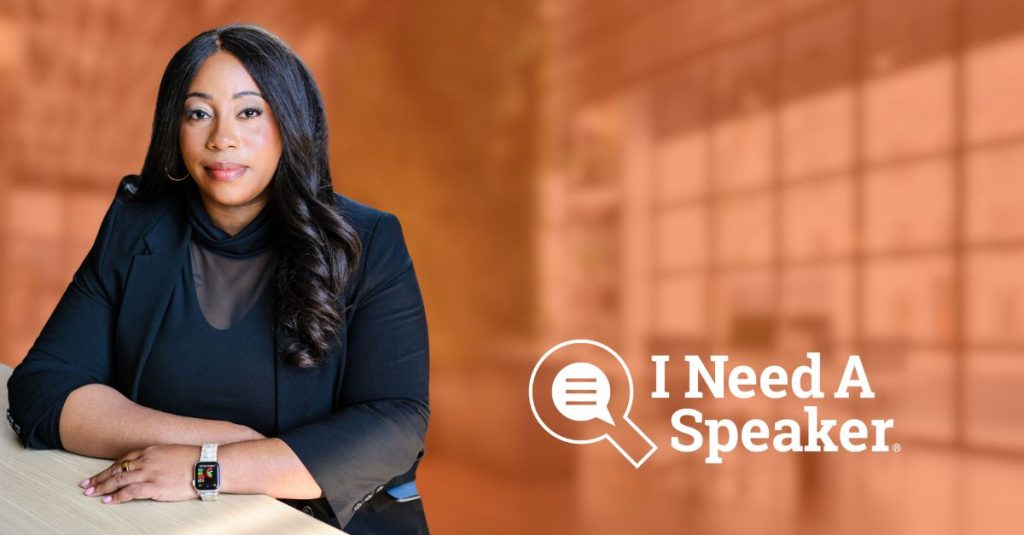
True leadership is less about climbing corporate ladders to get to a specific seat and more about our mindset and approach to work, regardless of where you sit within an organization. Tiffany Tate, keynote speaker and Founder/CEO of Career Maven Consulting, understands that for many mid-career professionals this means unlocking an invisible ceiling to effectively manage career growth while driving impact at work.
Whether you’re struggling with imposter syndrome, seeking work-life balance, or building development programs for your organization, Tiffany offers practical insights that bridge the gap between potential and performance. From her personal journey through motherhood and burnout to her strategic framework for sustainable success, Tiffany provides a refreshing perspective on what leadership can and should be in today’s workplace.
INAS: What inspired you to found Career Maven Consulting, and how has your vision for leadership development evolved since then?
TT: I founded Career Maven Consulting to help ambitious professionals and the organizations where they work decide and do good work on purpose. We do that through coaching, leadership development, and talent advisory solutions. Early in my career, I saw too many talented professionals being overlooked or undervalued in the workplace. I wanted to create a space that bridges the gap between potential and performance, with actionable tools that are both human centered and results driven. That same mission led me to write my book Decide and Do Good Work, which is a call to action for mid-career professionals to own their career story and define success on their own terms, with intention. Over the years, my vision has since expanded from solely individual career coaching to include partnership with organizations to build scalable talent strategies that drive workplace culture around employee engagement, leadership development and talent retention.
INAS: How has becoming a mother influenced your perspective on work life balance and career development?
TT: Motherhood has made me even more unapologetic about protecting my time, my energy, and my values. It has deepened my understanding that career and leadership success isn’t just about climbing a ladder, it’s about building a life. I talk about this in Decide and Do Good Work—the importance of aligning your decisions with your values and your vision–not what you think others expect from you. My daughter reminds me daily that being present and radically yourself, whether at work or at home, is a leadership act in itself. That clarity (and surviving burnout earlier in my career) helps me strive to model what success really looks like for me at this life stage in a much more sustainable way.
INAS: What boundaries or routines have helped you balance your personal and professional commitments?
TT: I live by two things: intentional planning and fierce boundary setting. I’m serious about using my calendar to protect deep work time, self care, and family time. I also have set work hours. I’m not available 24/7, and that is by design. In Decide and Do Good Work, I talk about the power of decision making with a priority framework rather than a to do list: deciding what matters most, and aligning your time accordingly. I often work in sprints, I unplug to recharge, I’m an expert delegator, and I say “no” or “not right now” without much guilt these days. Those practices aren’t luxuries, they are necessary for me to lead well and live well.
INAS: The events industry often requires long hours and extensive travel. What advice would you offer to professionals in the field for avoiding burnout while advancing their careers?
TT: My advice: Be proactive about rest. Build recovery time into your calendar before and after events. Clarify your non-negotiables, whether it’s sleep, meals, or movement, and treat them as sacred. You can’t pour into others if you’re constantly running on empty. Also: revisit your definition of success regularly. You don’t have to do everything to do deeply meaningful work that makes an impact.
INAS: What emerging trends do you see shaping the future of leadership development and employee engagement? How can event professionals use these trends to create more engaging events?
TT: The future of leadership development is deeply personal and experiential. We’re seeing a shift toward coaching-based leadership, real time feedback loops, and a deep need for inclusion and belonging at work. People want to feel seen, heard, and equipped to lead in complex environments that are constantly changing. For event professionals, this means designing more interactive, human centered experiences. Think immersive sessions, smaller breakout formats, and events that center learning, not just logistics and buffet lines. Create moments for event attendees that help people reflect, take action, and make real connections.
INAS: What strategies would you recommend for building stronger connections between speakers and audiences during live events?
TT: Strong connection starts before the mic is even on. Speakers should do their homework: know who’s in the room and what they care about. Use stories. Ask questions. Make the content about the audience, not just your personal story (although that’s important, too!). I also love using live engagement tools like polls, breakout discussions, and real time Q&A to build energy and two way interaction. A great keynote should feel like a conversation, not a lecture. That’s something I prioritize in every keynote experience when I hit the stage. It’s not about performance, it’s about providing a transformation.
INAS: What advice would you give speakers experiencing imposter syndrome?
TT: Imposter syndrome thrives in isolation and comparison. If you’re in the room, you’re meant to be there. Focus on the impact you want to make rather than the pressure to be or seem perfect. I remind myself often: I’m not here to impress, I’m here to provide value. Reframe the fear you feel as evidence that you care. Confidence grows through consistent action. Your confidence isn’t something you earn after success. It’s something you build while doing the work.
INAS: How should companies approach training and professional development?
TT: Companies should approach training & development as an investment in culture, not just a checkbox activity. That means aligning development opportunities with real business goals and the career aspirations of your people. It’s not just about what the company wants to teach, it’s about what employees need to thrive in their roles today and in future. I often help companies build talent development strategies that start with clarity and end with impact. Whether through workshops or coaching at scale, our team at Career Maven Consulting uses the Good Work framework to help professionals and teams focus, prioritize, and drive impact.
INAS: Describe the benefits companies can expect from offering development opportunities.
TT: Retention. Engagement. Innovation. When people feel supported and seen at work, they stay longer, contribute more effectively, and take ownership of their growth. Companies that invest in leadership development don’t just build better employees, they build better workplace cultures and future proof their organization from within. It’s a win for the business and the humans inside it. Development isn’t just a perk, it’s a sustainability strategy. When you equip people to take ownership of their career and leadership growth, you create environments where professionals can truly decide and do good work.
—
Prioritizing intentional career development is both a business necessity and a personal benefit. By incorporating Tiffany’s approaches, organizations can create cultures where professionals feel seen, equipped, and empowered to lead authentically.
And for individuals, embracing the principles from her book “Decide and Do Good Work” means defining success on your own terms while creating sustainable pathways for growth. After all, as Tiffany demonstrates through her coaching and speaking, leadership isn’t about perfection or performance. It’s also about alignment, intention, and making an impact that matters. Whether you’re planning your next career move, designing development programs, or simply seeking to show up more authentically at work, remember: confidence isn’t something you earn after success, it’s something you build while doing the work. Email info@ineedaspeaker.com to book Tiffany to speak at your next event.